
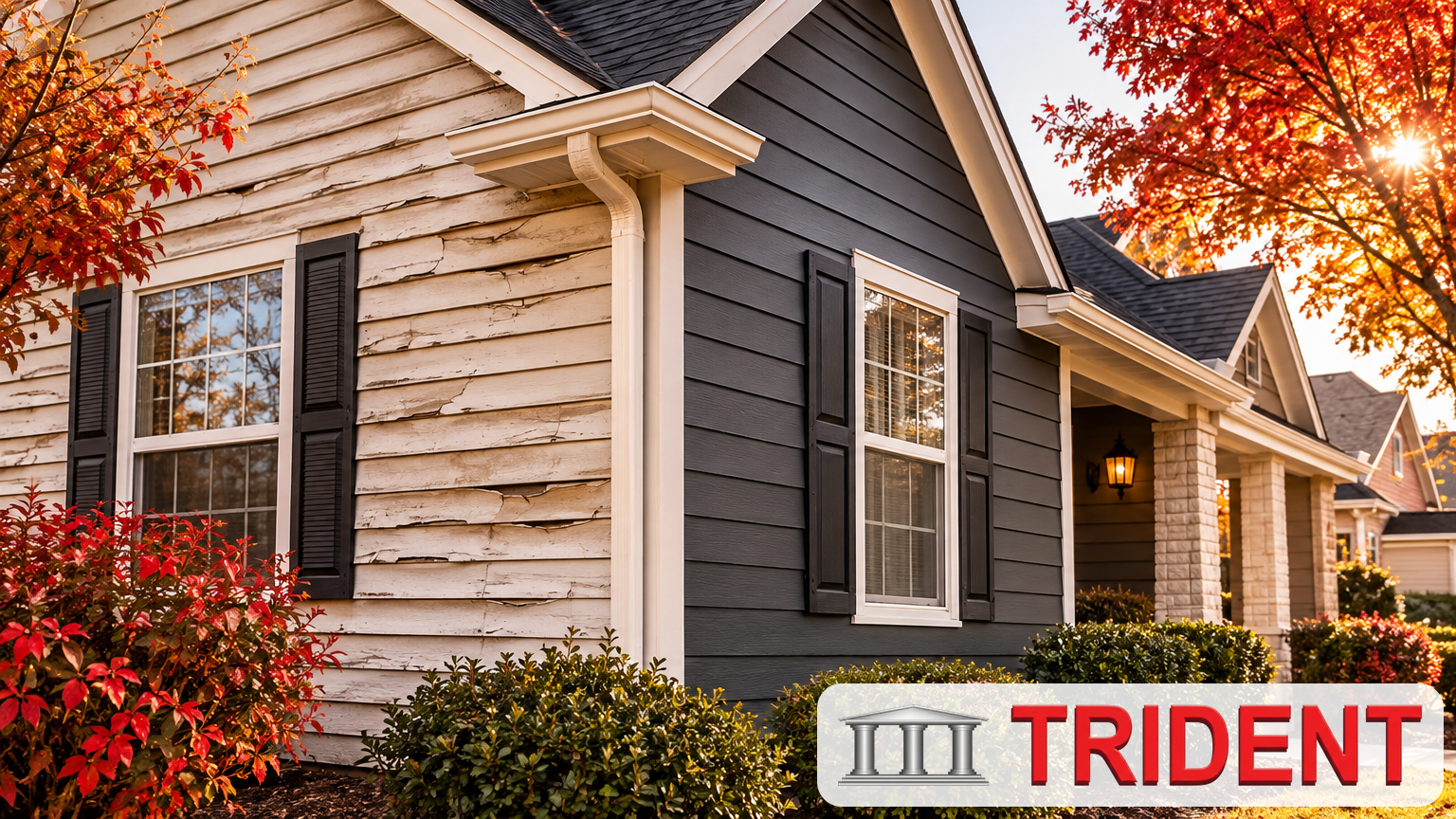
7 Warning Signs Your McKinney Home's Siding Needs Attention Before Winter

Paul Willi
Owner, Trident General Contracting (35 Years in North Texas)
Most McKinney homeowners don't think about their siding until something is visibly wrong — a board hanging loose, paint peeling off in sheets, or a draft coming through a wall that shouldn't have one. But by the time it's that obvious, the siding has usually been letting moisture, pests, and outdoor air into your home for a while.
The good news: siding problems almost always give you warning signs first. If you know what to look for, you can catch issues early — before a wet, cold North Texas winter turns a minor repair into a major project.
This guide walks you through the seven most common warning signs that your siding deserves a closer look right now, while the weather is still mild enough to work comfortably and before the busy spring season drives up wait times.
Not sure if what you're seeing is serious? Book a free consultation with Trident General Contracting. Owner Paul Willi and his team will take a look and give you an honest assessment — no pressure, no sales pitch.
Why Fall Is the Right Time to Check Your Siding in McKinney
North Texas summers are brutal. Months of intense UV exposure, triple-digit heat, and drought stress — followed by sudden heavy rains — put enormous strain on exterior siding materials. By the time October and November arrive, your siding has just come through one of its hardest seasons of the year.
Checking now matters for two practical reasons:
- Winter moisture is coming. McKinney winters aren't as harsh as farther north, but we do get freezing rain, ice storms, and extended cold snaps. Any crack, gap, or compromised section in your siding becomes a path for moisture to get in — and once water is behind siding in cold weather, it can cause wood rot, mold, and insulation damage that's expensive to fix.
- Scheduling is easier now. Spring is the busiest time for exterior work in North Texas. Homeowners who identify issues in the fall can get on a contractor's calendar for winter planning and be first in line when build weather opens back up.
With that context in mind, here are the seven signs to look for.
Sign 1: Visible Cracks, Chips, or Gaps in the Siding Panels
Walk the perimeter of your home and look closely at every panel, board, or section of siding. Cracks and chips in vinyl siding are especially common after a hot Texas summer — the material expands and contracts repeatedly in extreme heat, and over time the panels can crack, warp, or pull apart at the seams.
Fiber cement and wood siding can develop cracks too, particularly at corners, around window and door frames, and anywhere two panels meet. Even a small gap is enough for water to get behind the cladding, where it can saturate the sheathing and framing beneath.
What to do: If you find cracks in one or two isolated panels, that area may be repairable. If the cracking is widespread or you're seeing it throughout the same wall, it often indicates the siding material has reached the end of its service life and replacement is worth considering.
Sign 2: Bubbling, Buckling, or Warped Panels
Siding that is bubbling, bowing outward, or visibly wavy has a moisture problem — almost without exception. When water gets trapped between the siding and the wall, it has nowhere to go. Heat from the Texas sun can accelerate this effect, causing panels to expand unevenly and lose their flat profile.
Bubbling in vinyl siding is a telltale sign that water is already present behind the panel. Warping in wood or fiber cement siding often signals prolonged moisture exposure or inadequate caulking around penetrations. Either way, what you can see on the surface is usually only part of the picture — the more important question is what's happening to the sheathing and framing underneath.
This is one warning sign that warrants a professional eye. A contractor experienced in siding installation can open a section to assess whether the damage is confined to the outer layer or has affected the structure behind it.
Sign 3: Paint That Is Peeling, Fading Excessively, or Failing to Bond
If your home has painted wood siding and the paint is peeling in large sections — especially on walls that get direct afternoon sun — the siding itself may be the problem, not just the paint job. Paint that refuses to stay bonded to the substrate is often a sign of moisture cycling through the material from behind, or a siding surface that has deteriorated beyond the point where paint can adhere properly.
Even on homes with factory-finished siding products, significant color fading in just a few years can indicate that the protective coating is breaking down faster than it should, which leaves the material more vulnerable to moisture and UV damage going forward.
Repainting over siding that has an underlying problem rarely solves anything for long. It's worth finding out whether the siding itself needs to be addressed before spending money on new paint.
Sign 4: Soft Spots, Sponginess, or Any Sign of Rot
This sign requires a hands-on check. Using a screwdriver or the blunt end of a tool, gently press or tap on the siding and the trim boards around your windows, doors, and corners. Healthy siding — even wood — should feel firm. If anything feels soft, spongy, or hollow, or if the tool punctures the surface with minimal pressure, that section has rotted.
Wood rot is caused by sustained moisture and spreads to adjacent materials over time — including the structural framing behind the siding. In North Texas, homes that experienced flooding, foundation settling, or repeated storms without prompt exterior repairs are particularly prone to this.
Rot does not heal or stabilize on its own. If you find it, the affected material needs to be removed and replaced, and the source of moisture that caused it needs to be addressed, or the rot will return.
Sign 5: Higher Energy Bills Without Another Obvious Cause
Your siding is part of your home's thermal envelope — the barrier between conditioned indoor air and the Texas outdoors. When siding is cracked, improperly installed, or separating at the seams, that envelope develops gaps and your HVAC system works harder to compensate.
If your energy bills have been climbing over the past year or two and you've already ruled out HVAC performance issues, it's worth taking a look at your exterior. Gaps where siding meets trim, missing or deteriorated caulking, and panels that have pulled away from corner posts are all places where conditioned air escapes and outdoor air infiltrates.
This is one of the less obvious warning signs, but it's one that affects your wallet directly every month — not just at the point of repair.
Sign 6: Mold, Mildew, or Algae Growth on the Siding Surface
Some surface mildew on siding is a cosmetic issue that can be cleaned. But if you're seeing persistent mold or algae growth — especially in the same spots season after season, or in areas that shouldn't be staying wet — that's a sign the siding may be retaining moisture it shouldn't be.
In North Texas, the north and east faces of a home tend to stay shadier and retain moisture longer. Algae growth in those areas is fairly common. What to watch for is growth that keeps coming back quickly after cleaning, or dark staining that penetrates the surface of the material rather than sitting on top of it. That can indicate the siding material is absorbing moisture, which accelerates deterioration.
Interior signs matter here too: if you're noticing musty odors inside rooms on an exterior wall, or seeing mold appear on interior drywall without a plumbing source, the exterior siding and sheathing should be on your inspection checklist.
Sign 7: Siding That Is Simply Old
Different siding materials have different expected service lives, and those are general ranges — actual performance depends on installation quality, maintenance history, and climate exposure. If your McKinney home's siding is approaching or past the typical range for its material type, it's worth having a professional assess whether it's holding up well or starting to show its age in ways that require attention.
Even siding that looks acceptable on the surface can be deteriorating in the areas you can't easily see — behind downspouts, under eaves, in corners, and around penetrations. An older home with original siding that has never been replaced is worth a professional walkthrough, particularly before winter.
Age alone isn't a reason to rush into replacement, but it is a reason to know what you're working with.
Seeing one or more of these signs on your home? Don't wait until winter weather makes the problem worse. Contact Trident General Contracting today for a free consultation — we'll walk your property with you and give you a straightforward picture of what's going on.
Quick Siding Self-Inspection Checklist for McKinney Homeowners
Use this checklist in the fall and again in spring. Walk the full perimeter of your home in good daylight and check each item:
- ☐ No visible cracks, chips, or breaks in any panel
- ☐ All panels sit flat — no buckling, bubbling, or bowing
- ☐ Paint or finish is intact with no large peeling sections
- ☐ No soft spots or sponginess when pressed on trim and panels
- ☐ Caulking around windows, doors, and corner boards is intact and not cracked
- ☐ No visible gaps where panels meet trim or each other
- ☐ No persistent mold or mildew staining on the siding surface
- ☐ Siding around any penetrations (vents, hose bibs, electrical boxes) is tightly sealed
- ☐ No signs of pest activity — holes, trails, or entry points in the siding
- ☐ Interior walls adjacent to exterior don't show any moisture staining or musty odor
If you check three or more of these as a concern, it's time for a professional assessment.
Frequently Asked Questions About Siding in McKinney, TX
How do I know if I need a repair or a full siding replacement?
That depends on the extent and location of the damage, the age of the siding, and the material type. Isolated panel damage in an otherwise sound system can often be repaired effectively. But if the damage is widespread, if there's underlying rot or sheathing damage, or if the siding material is past its reliable service life, replacement typically makes more sense — a repair in one area may just be followed by problems in others shortly after. A contractor can walk the property with you and give you an honest read on which makes more sense for your specific situation.
What siding materials work best in North Texas?
North Texas presents a specific set of challenges: intense heat, UV exposure, drought cycles, and periodic severe storms including hail. Several materials perform well here, each with trade-offs in cost, maintenance, and appearance. Fiber cement siding is popular in this climate because it handles heat and moisture well and holds paint effectively. Engineered wood and certain vinyl products can also perform well when properly installed. The right choice depends on your home's existing structure, your aesthetic goals, and your maintenance preferences. This is worth discussing in detail during a consultation, because installation quality matters as much as material selection.
Do I need a permit for siding replacement in McKinney?
Permit and inspection requirements vary by city and by the scope of work. McKinney has its own building department with specific requirements, and those can change. As a general rule, full siding replacement on a residential structure may require a permit, particularly if it involves changes to the building envelope or structural sheathing. Trident General Contracting handles permitting for the projects we manage — confirm specific requirements with the City of McKinney's building department and with your contractor before work begins.
How long does a siding project typically take?
Project timelines vary significantly based on the size of the home, the material being installed, the extent of any underlying repairs needed, and weather conditions. A smaller home with a straightforward installation and no significant underlying repairs will move faster than a larger home with areas of rot or sheathing damage that need to be addressed first. Your contractor can give you a realistic timeline after assessing the property — this is one of the things we cover during a free consultation at Trident.
Can I stay in my home while siding work is being done?
In most cases, yes. Siding installation typically does not require the home to be vacated. There will be noise, some disruption to the exterior of the home, and areas of the yard may need to be temporarily cleared for staging materials and equipment. Your contractor will walk you through what to expect before work begins.
What Happens at a Free Consultation with Trident General Contracting?
If you're not sure whether what you're seeing on your home's siding is a minor issue or something that warrants real attention, a free consultation is the right starting point — and there's no obligation attached to it.
Here's what to expect:
- A walkthrough of your property. Paul or a member of the Trident team will walk the exterior of your home with you, looking at the siding, trim, and surrounding areas with experienced eyes. With 35 years in the industry, we've seen the full range of what North Texas weather and time can do to a home's exterior.
- An honest assessment. We'll tell you what we see, what it means, and what the realistic options are — including if the answer is that it's not urgent. We don't oversell work that isn't needed.
- A conversation about your goals and timeline. Whether you're trying to get ahead of winter, planning for spring, or just want to know where things stand, we'll talk through what makes sense for your situation.
- Next steps, if any. If siding work makes sense for your home, we'll talk about scope, process, and what the project would involve — no guesswork, no surprise scope.
Trident General Contracting serves McKinney and the surrounding North Texas area including Plano, Allen, Frisco, Richardson, Garland, Carrollton, and more. Learn more about our siding installation services or reach out directly to get started.
Don't Wait for Winter to Find the Problem
Siding issues don't get better on their own, and North Texas winters — while milder than much of the country — bring enough moisture and cold to accelerate existing damage. A problem that's manageable today can be a significantly larger project by spring.
If you walked through this list and found yourself checking one or more boxes, trust that instinct. A free consultation costs you nothing and gives you a clear picture of where your home stands. That's valuable information — whether the answer turns out to be "all clear" or "let's talk about next steps."
Schedule your free siding consultation with Trident General Contracting today. Serving McKinney, Plano, Allen, Frisco, and throughout the North Texas area.
About the Author: Paul Willi
Paul Willi is the owner of Trident General Contracting in Plano, Texas, with 35 years of experience in residential and commercial construction. Trident GCS serves homeowners across the North Texas area, including McKinney, Allen, Frisco, Richardson, Garland, Carrollton, and Plano, with services including siding installation, roofing, home additions, decks, garages, and more.

Ready to build something beautiful?
Tell us about your project and book a free, no-obligation consultation.