
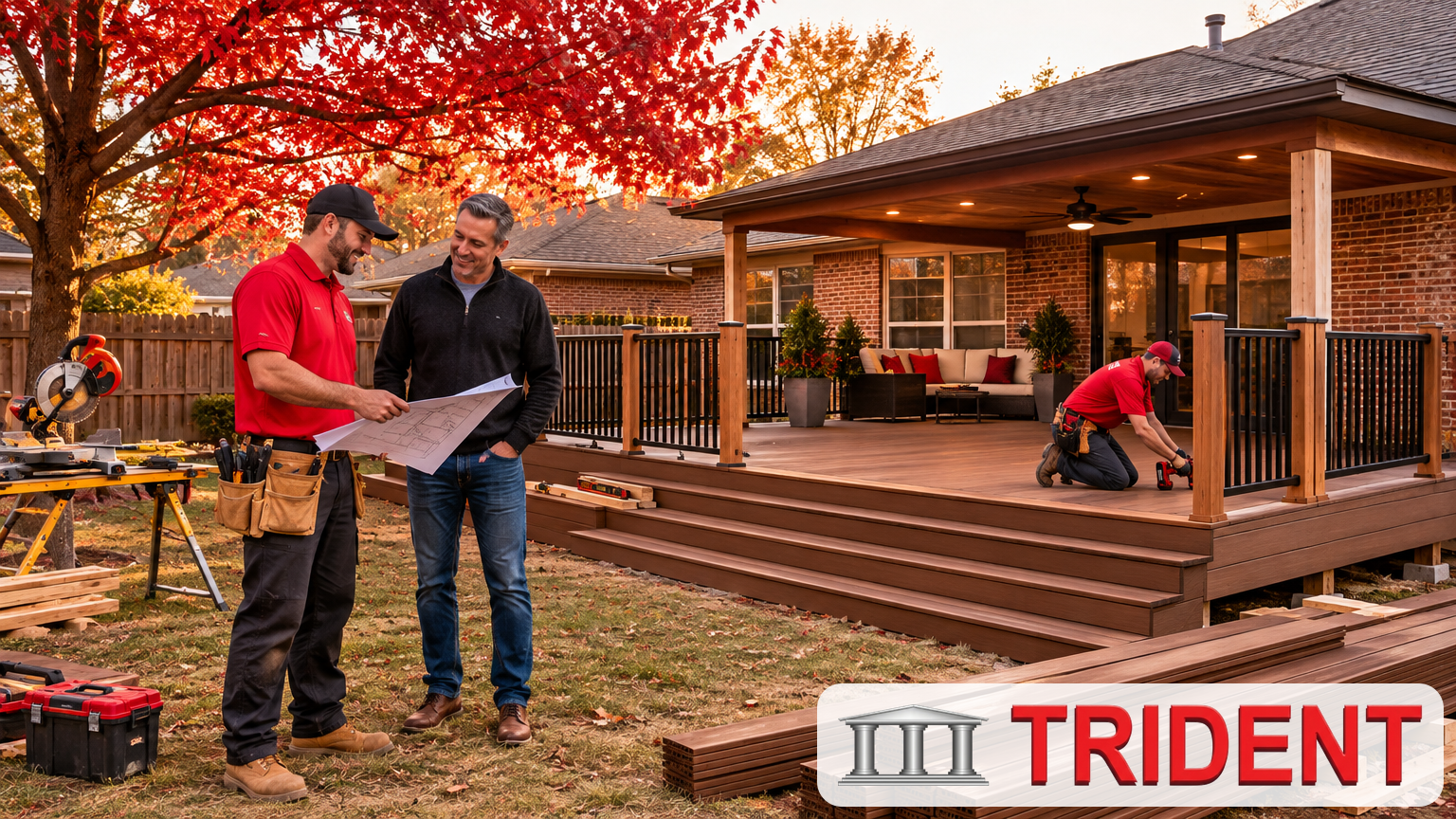
Ready to Build a Deck in Plano? Here's Exactly What the Process Looks Like

Paul Willi
Owner, Trident General Contracting (35 Years in North Texas)
You’ve made the decision. You want a deck. You can picture it — weekend mornings with coffee, evenings with family, more usable space without adding square footage under roof. Now comes the part most Plano homeowners are less sure about: what actually happens between that first phone call and the day you’re standing on a finished deck?
This post walks you through the entire deck construction process, step by step, in plain language. If you’re a Plano homeowner who is past the “should I build a deck?” stage and into “how do I actually do this?” — this is written for you.
And right now, late fall into winter, is one of the smartest times to get this process started. Spring is the busiest season for deck builds in North Texas. Homeowners who plan and permit now are the ones who are enjoying their new decks by April or May.
Ready to get started? Book a free consultation with Trident General Contracting and we’ll walk your property, talk through your vision, and lay out exactly what your deck project involves. Schedule your free consultation here or call (972) 309-9513.
Why Winter Is the Right Time to Plan Your Plano Deck
North Texas winters are mild compared to most of the country, but they do slow outdoor construction. More importantly, they create a window that smart homeowners use to their advantage.
When you start the planning process in November or December, here is what you gain:
- Permit lead time. The City of Plano requires a building permit for most decks — particularly attached decks and any structure above a certain height or square footage. Permit review takes time, and that clock starts ticking only after you submit a complete application. Getting your permit in December means it may be approved and in hand before the spring rush begins.
- Contractor availability. General contractors and their crews are less scheduled in winter. You get more attention during the planning phase, and you are more likely to land a preferred start date.
- Time to make good decisions. Rushing a deck design leads to regrets — a staircase in the wrong place, not enough room for a table and chairs, the wrong material for North Texas heat. A winter planning window gives you time to get the design right before anyone picks up a saw.
With a publish date in late November, your spring deck is very much within reach if you act now.
Step 1: The Free Consultation — What to Expect
The process begins with a conversation and a property visit. At Trident General Contracting, the free consultation is not a sales pitch — it is a working meeting where we learn about your property, your goals, and your project.
Here is what happens during a typical first consultation for a deck project:
- We walk the site together. Paul or a member of the Trident team visits your Plano home to look at the space where the deck will be built. We look at grade (how the ground slopes), proximity to the foundation, existing structures, drainage patterns, and access.
- We talk about how you plan to use the deck. A deck for large gatherings is designed differently than one for a quiet seating area. Do you want a built-in bench, a spot for a grill, overhead shade, or stairs that connect to a yard? All of this shapes the design.
- We discuss material options. Pressure-treated wood, composite decking, and other materials all have different characteristics in the Texas climate. We will walk through the trade-offs honestly so you can make an informed choice.
- We talk through the permit and code requirements. Permit and inspection requirements vary by city and by project scope. We will give you an honest picture of what the City of Plano is likely to require for your specific project, though you should always confirm current requirements directly with the city and with us before final decisions are made.
- We discuss scope and next steps. By the end of the consultation, you should have a clear picture of what your project involves and what comes next.
There is no pressure and no fee. If the project is not a good fit or if the timing does not work, we will tell you honestly.
Step 2: Scope, Design, and Proposal
After the consultation, Trident puts together a written project scope and proposal based on what was discussed. This is not a vague estimate — it describes the work, the materials, and the sequence so you know exactly what you are agreeing to.
At this stage, a few key decisions get finalized:
- Deck size and shape. Square footage drives materials and labor. The shape — a simple rectangle, an L-shape, a wrap-around — affects complexity and framing.
- Attachment method. Attached decks that connect to the house require a ledger board that ties into the home’s structure. This detail matters for both engineering and permits.
- Height and stair configuration. A ground-level deck has different structural requirements than an elevated one. Stairs need to meet code for rise, run, and handrail height.
- Railing design. Railings are both a safety requirement (for decks above a certain height) and a design element. Material and style choices are made here.
- Decking material. The surface boards you walk on. In North Texas, heat, UV exposure, and occasional moisture all affect how materials perform and what maintenance they will require over time.
Once you review the proposal and have any questions answered, you decide whether to move forward. No decision is made for you.
Step 3: Permits and Approvals
Once you approve the proposal, Trident handles the permit application process. For most attached or elevated decks in Plano, a building permit is required. The permit application typically includes a site plan showing where the deck will be located on your lot, a construction drawing showing the framing, and details about materials and connections.
Permit review timelines vary. The City of Plano’s building inspection department processes permit applications in the order received, and review time depends on their current volume. This is one of the main reasons starting in winter is so valuable — you are not waiting on a permit while spring weather is perfect for building.
Always confirm current permit requirements and timelines directly with the City of Plano and with your contractor before making scheduling assumptions.
Not sure what permits your deck project requires? That’s exactly the kind of question we work through together during the free consultation. Book yours today — no obligation, no fee.
Step 4: Material Procurement
Once the permit is approved, materials are ordered and scheduled for delivery. Procurement is not an afterthought — it is a planned step that affects the construction timeline.
A few things to know about materials for North Texas deck builds:
- Pressure-treated lumber is the standard framing material. It is designed to resist rot and insects. Proper drying time after installation is important before some finishes can be applied.
- Composite decking is popular in Plano because it handles heat and UV better than untreated wood, requires less maintenance, and does not splinter. It carries a higher upfront cost than treated lumber decking.
- Fasteners and hardware matter more than many homeowners realize. Corrosion-resistant hardware is required at the ledger connection and in other critical locations. These are code requirements, not optional upgrades.
- Concrete and footings. Deck posts rest on concrete footings that go below the frost line and are sized based on the load they carry. The footing design is part of the permit drawings.
Step 5: Construction
This is the part most homeowners are most familiar with — the actual building. Here is a general sequence for a typical attached deck in Plano:
- Layout and footing installation. Post locations are marked, holes are dug, and concrete footings are poured. The footings need to cure before posts are set.
- Post setting and beam installation. The vertical posts are set and the horizontal beams that carry the deck frame are installed.
- Ledger attachment (for attached decks). The ledger board that connects the deck frame to the house is attached to the home’s rim joist or band joist with approved hardware. Flashing is installed to prevent water from getting behind the ledger.
- Joist framing. The floor joists that span between the beam and the ledger are installed. Joist spacing determines the stiffness of the deck surface.
- Decking installation. The surface boards are installed, either with face screws or hidden fasteners depending on the material and design.
- Stair framing and installation. Stair stringers are cut and installed, then treads are added. Stair dimensions must meet code.
- Railing installation. Posts, rails, and balusters are installed. Railing height and baluster spacing are code requirements.
- Final inspection. The City of Plano’s building inspector reviews the finished deck to verify it was built to the permitted drawings and to code. Passing final inspection is required to close the permit.
Timelines vary by project size, weather, and crew schedule. We do not publish specific timelines because every project is different — that is a conversation we have based on your specific scope.
Your Pre-Consultation Checklist
Before you meet with a contractor, a little preparation goes a long way. Here is a simple checklist for Plano homeowners getting ready for a deck consultation:
- ✅ Know the approximate location where you want the deck and whether you want it attached to the house or freestanding
- ✅ Have a rough sense of the size you want (even a ballpark helps — small patio, medium entertaining space, large multi-level)
- ✅ Note any existing features that affect placement: AC units, gas meters, hose bibs, windows, or doors
- ✅ Think about how you will use the deck (dining, grilling, lounging, play space) so the contractor can flag design considerations
- ✅ Pull out your property survey if you have one — it shows setback lines the deck must stay within
- ✅ Have a sense of your preferred decking material direction (wood vs. composite) but be open to learning the trade-offs
- ✅ Write down any questions you have about permits, process, or timeline so you don’t forget them
Common Mistakes Plano Homeowners Make When Planning a Deck
After 35 years in the construction industry, Paul Willi has seen the same mistakes come up on deck projects again and again. Here are the most common ones — and how to avoid them.
Skipping the permit. Some homeowners try to avoid the permitting process to save time or money. This is a serious mistake. An unpermitted deck can create issues when you sell your home, may not be insurable, and can be ordered removed by the city. Always permit your deck.
Sizing the deck without thinking about furniture. A 10×10 deck sounds reasonable until you put a table, four chairs, and a grill on it. Think through how you actually plan to use the space before locking in dimensions.
Choosing material based only on upfront cost. The least expensive material upfront is not always the least expensive over ten years when you factor in maintenance, refinishing, or replacement. Ask your contractor for an honest breakdown of long-term performance.
Not thinking about drainage. Plano gets significant rainfall at certain times of year. How water drains away from the deck — and from beneath it — affects how long the structure lasts and how comfortable the space is during and after rain.
Not asking about the ledger connection. The ledger — where an attached deck connects to your home — is the most structurally critical and moisture-sensitive part of the build. Ask your contractor specifically how they handle the ledger connection and flashing. A well-built ledger protects both the deck and your home.
Frequently Asked Questions
Does a deck in Plano require a permit?
Most decks do, particularly attached decks and elevated decks above a certain height. The City of Plano’s building inspection department is the authority on this — requirements can depend on the deck’s size, height, and attachment method. Trident works through the permit process with you, but always confirm current requirements with the city directly.
How do I know if my HOA has rules about decks?
Many Plano neighborhoods have HOAs with architectural review processes. If your property is in an HOA, you should check your CC&Rs and submit for HOA approval before or alongside your permit application. HOA approval and city permit approval are separate processes. We can build to HOA specifications, but you are responsible for the HOA review and approval.
What is the difference between pressure-treated wood and composite decking?
Pressure-treated lumber is wood that has been chemically treated to resist rot and insects. It is a proven material but requires periodic sealing or staining to look its best and can splinter as it ages. Composite decking is an engineered product made from wood fiber and plastic — it handles UV and moisture well, requires less maintenance, does not splinter, but typically costs more upfront. Both are legitimate choices; the best one depends on your budget, maintenance preferences, and aesthetic goals.
Can I build a deck in winter in Plano?
Yes. North Texas winters are mild enough that deck construction can proceed most of the season. Cold and wet weather can cause delays, but framing and decking installation are not weather-sensitive the way, say, concrete flatwork or exterior painting can be. Planning and permitting in winter with a construction start in late winter or early spring is a common and smart approach.
What does Trident’s free consultation actually cover?
The free consultation is a no-pressure, no-fee meeting at your Plano property. We walk the site, talk through your vision and how you plan to use the deck, discuss material options and their trade-offs, explain the permit and inspection process, and answer your questions. By the end, you will have a clear picture of what your project involves. If you decide to move forward, we prepare a written proposal. If you decide not to, there is no charge and no pressure.
What Happens Next
If you are a Plano homeowner who is ready to move forward with a deck build — or even just seriously considering it — here is exactly what your next step looks like:
- Contact Trident General Contracting by calling (972) 309-9513 or filling out the form at tridentgcs.com/contact. Tell us briefly what you have in mind.
- We schedule your free consultation. We will arrange a time to visit your property that works for your schedule.
- We walk your property together. The site visit takes the guesswork out of the process. We can answer questions on the spot that would take days to resolve over the phone.
- You receive a written proposal. No verbal estimates, no vague numbers. A written scope of work so you know what you are approving.
- Permits are filed. Once you approve the proposal, we handle the permit application. This is when the clock starts — and why starting now gives you the best chance of a spring build.
Spring deck season in Plano is not far off. The homeowners who start the process now are the ones who will be using their new decks in April. The ones who wait until March will be waiting until summer.
Book your free deck consultation with Trident General Contracting today. No fee, no pressure — just an honest conversation about what your project involves and what comes next. Get started at tridentgcs.com/contact or call (972) 309-9513.
Learn more about our general contracting services in Plano, TX and what Trident General Contracting brings to every project.
About the Author: Paul Willi
Paul Willi is the owner of Trident General Contracting LLC, a general contractor based in Plano, Texas. With 35 years of hands-on experience in residential construction, Paul founded Trident on a foundation of craftsmanship, honest communication, and pride in the work. Trident serves homeowners throughout Plano and the surrounding area. Contact Paul’s team for a free consultation.

Ready to build something beautiful?
Tell us about your project and book a free, no-obligation consultation.